Why Justin Holt specializes in Craft CMS
Thomas Sausen
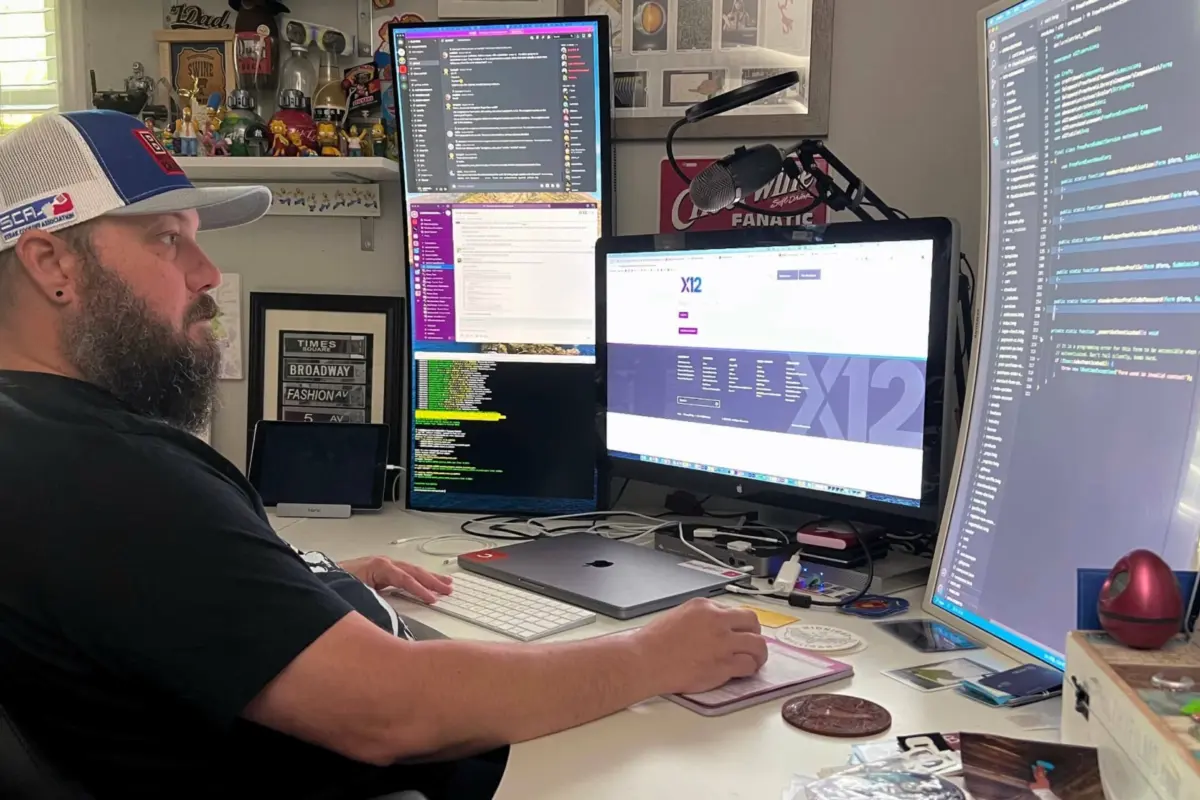
Justin Holt is a web developer from Charlotte, North Carolina, who built his first website in 1996 and specializes in Craft CMS. He runs the Charlotte Craft Meetup and spoke at Dot All 2022 about a different approach to content modeling. This is an edited transcript of our conversation on the CraftEntries podcast, recorded in the summer of 2022.
Hi Justin, thank you for taking the time. Before we start, could you tell me a little about yourself?
Sure. I live in Charlotte, North Carolina, in the U.S., and I'm a long-time web developer. I built my first website in 1996, in college, and I've made every type of site you can imagine. For the last five years, I've specialized in Craft CMS, Yii, and PHP. I do both front-end and back-end development, and I run my own web development and consulting firm. Essentially, I'm a freelancer working as a business, for different agencies in the U.S. and Europe, on Craft development, consulting, and training. Over the last eight to ten months, I've done a lot of consulting, helping other Craft development teams improve their proficiency in Craft.
I also run the local Charlotte Craft Meetup group. We meet monthly and talk about development topics like Craft security and hosting. We try to reach a broad range of skill levels and spread interest in Craft CMS. I love PHP, Craft, and Yii, so I'm definitely an evangelist. I've used many different CMSs over the years, like WordPress, Drupal, ExpressionEngine, and Magento, and I think the developer and editor experience is by far the best with Craft CMS and Yii. At this point in my career, I've settled into specializing in Craft.
From freelancer to Craft specialist
How did you get from college to becoming a web developer?
As soon as I graduated from college in 2001, I started marketing myself nationwide for custom website development. I branded myself as Aqua, like water, because I saw myself as fluid and able to build any website. I did pretty well and lived off that for seven or eight years after college. In 2007, I moved back to Charlotte, where I grew up. It's one of the larger cities in the Southeast, and I wanted to try working for agencies, so I worked for five or six different agencies in the area. I liked it in some ways, but I missed setting my own schedule and doing my own things. In 2019, I decided to go back to freelancing full-time.
What was the first proper CMS you used for clients?
That would be WordPress, in its very early days. I went to one of the first WordCamps, in Richmond, Virginia. I found WordPress really neat and very polished, even at that early stage. One thing I had never handled well in the basic content management setups I put together was image management and image uploads. WordPress gave my client base real control over images, and that's when I started diving into WordPress.
Around that time, I started leveling up on object-oriented programming and learned a bit of CodeIgniter. I ran into business problems that WordPress and Magento weren't built for, so for more custom development, I dove pretty heavily into CodeIgniter and worked with it for about a year, around 2010 or 2011. ExpressionEngine was gaining market share at the time, and I began migrating my WordPress clients to ExpressionEngine for its security and much greater flexibility. Getting away from the way WordPress handles everything in the loop eventually led me to Craft.
I didn't use Craft much when Brandon first started it. But then I worked at a Charlotte agency that embraced Craft, and there's no better time to learn a system than when you need it for your job. After the first couple of sites I built with Craft, I thought, "Awesome. Such a mature and well-structured platform."
You used ExpressionEngine because of CodeIgniter. What about Craft and Yii?
Now that I work in Yii so much, I appreciate that it favors configuration over convention, which is the opposite of CodeIgniter's convention over configuration. I like Yii's kind of MVC pattern a little better, which I probably wouldn't have said ten years ago. CodeIgniter works great, though, and I still have a couple of old sites built on it. It's just part of a developer's evolution. You're for one pattern and against another until you try the other one and end up liking it more.
Staying up to date
How do you stay up to date with web development trends?
I do a lot of reading in the evenings. Ten to fifteen years ago, the development community shifted to using tools and packages for front-end tooling. When Node and npm came out, it was hard not to feel overwhelmed. A colleague, Trevor Plassman, gave me some good advice:
Learn what you think will help you in your day-to-day work.
No human on this planet can know everything about web development. It has grown to the point where you have to pick your path and specialize.
Nowadays, with Craft, I spend a lot of time on Discord, reading about the challenges people face and seeing whether I can help, or whether I've faced something similar and how I solved it in Craft. I don't read many blogs anymore, but I do have a CraftQuest subscription, and I have to tip my hat to Ryan. CraftQuest is a great learning resource for developers from beginner to experienced, and I've spent a lot of time there watching and listening. I'm always tuned in to Andrew and Ryan's podcast devMode.fm, and I'm always there when Andrea and Ben do their Craft Twitter Spaces. Now that I specialize in Craft, I can focus on what happens in the Craft community, and I try to keep a balance between work and life so I don't get overwhelmed.
So why did you specialize in Craft CMS?
I had been working a lot in the Craft community, and at some point I decided that's where I would specialize. I had no shortage of leads and had to turn down work because I didn't have the time. I made the jump and have never been happier. I've worked for many well-known Craft development firms and broadened my skill set to include a lot of server management and plugin work. It's been fun. I love building websites, solving problems, and the satisfaction of helping a company do its business online, and I feel that Craft CMS is the best tool for that.
I also fell in love with the community. Out of all the web communities I've been part of in my career, the Craft community has the most open, sharing, and empathetic people you could ask for.
I've learned a lot and started sharing my knowledge with the community. We all welcome newcomers to the language and the platform and make them feel at home, which is better for all of us as Craft developers. It means more websites will be converted to Craft CMS, which means more work for all of us.
A different approach to content modeling
You're going to speak at Dot All 2022. What will your talk be about?
My topic is a different approach to content modeling in Craft. For a long time, a lot of developers, myself included, embraced the Matrix field, and many content managers on the client side really liked seeing all the content of a page in one place in the CMS. Matrix is easy to work with, especially with Neo or other plugins. But at the end of the day, managing all of a page's content with Matrix can lead to a huge number of queries. The big drawback is that the blocks in a Matrix field only live on that entry. There's no way to reuse them elsewhere unless you copy them to another page by hand.
Years ago, another developer showed me how he liked to manage content. He didn't use Matrix as the only way to manage the components on a page, and by components, I mean in the context of a build. He used various channels or structures as components, say a hero channel and a grid channel, whatever your build needs, and relational fields like Entries fields to control what gets pulled into a particular entry. At first, I thought, "That's going to be kind of weird," because you don't manage most of the content on the page you're editing in the CMS. But in Craft 3, we already had the little slideout editor, where you could double-click a related entry and edit some of it.
I still like that content model because it allows repeatable content and blocks that can be reused across different entries. If you use the same CTA block on various pages, you only have one of it and manage it for all those entries, and you can still arrange the blocks with drag and drop in an Entries field. It took some time to get used to, but once I started modeling my sites and schemas that way, I found that it significantly reduced the number of queries and also made saving entries faster. If you've ever saved a draft of a page built with a Matrix content builder, say an entry with 17 different blocks, you know it takes a while, because a lot of queries are happening.
I still use Matrix, but in a cleaner pattern that separates the components and their content from the actual entries. I think it's the better way to structure your schema and manage your content. The one drawback is that you need a client who understands this pattern. But with Craft 4 and its improved full slideout editor, you can manage all the "component entries" you include on a page directly from the entry itself. I'll try to show that in my talk, and I'm building a demo website to show how the concept works in the real world.
I think Matrix is fantastic, but I feel like there's a limit you can reach that will eventually start hindering performance.
Some clients get messy with Matrix, right?
It's easy to do, and I still do it myself on some projects. You have to gauge your clients, especially if they come from another CMS like WordPress. They're used to managing all the content on a page and thinking in pages, not in a build system where content is a first-class citizen across the whole site.
As Craft developers, we're up against competition like Webflow. Tools like that are maturing and embracing the build-your-own-page experience. If I can help develop that kind of experience and a way of approaching schemas in Craft, I think that helps us gain more market share too.
Before we go, is there anything you'd like to add?
I want to say to all the Craft developers out there, thank you for embracing Craft. The more websites we build or convert to Craft, the better for all of us as a community, because that means more work for all of us. Just keep the faith! I know there's been some angst in the community about the recent move from Craft 3 to Craft 4. Any major version jump on any platform has bumps in the road. I've converted quite a few sites to Craft 4, and some were easy while others were very challenging. If we keep moving Craft forward and giving as much feedback as possible, it will all get better.

Thomas Sausen
Web Developer